

Did you know that the very same water you use to wash your car is also capable of doing damage to your paint?
Some folks find that surprising, but it’s true!
When water evaporates from your car’s paint it leaves behind trace elements (creating spots and other damage). Calcium and metals in tap water are especially harmful.
Even rainwater can have harmful elements, but acids from all sorts of air pollutants are truly nasty!

The good news is getting rid of water spots is easy (if you chase after them).
A good conventional solution is a quick detailing spray after routine washing. That’s preventative.
Of course, sometimes you’ll discover spots afterwards (i.e., when your neighbor’s sprinkler gets you).
Whatever happens, never give water spots enough time to dry and bake on. Deal with it ASAP.
If you don’t act, those imperfections will attach to and harden on your paint. At that point, you’ll need to use a mild acid to get them loose. Avoid this whenever possible.
Don’t worry though.
It’s not the end of the world if your car has some bad water spots.
And, believe it or not, the best acid is also the least expensive and most available:
A gallon jug of distilled white vinegar.
Expert car detailers have known this secret for years.
Seriously! Take your car to a pro and you will be charged for the pleasure of smelling like a pickle.
Save your money. Put on some gloves and get to it.
Here’s how!
Remove Water Spots With Vinegar – The Easy Way
First, wash with your normal car shampoo. Rinse, and then use the distilled vinegar.
This will give your car the magic acid bath. Just wipe it on with a sponge, and rub it in.
Pro Tip: Do only one section at a time. Let it sit 30 to 60 seconds. Then rinse.
When you’re done, wash the car again with shampoo. Then rinse again.
There is a downside to this technique…
The vinegar will remove your wax. Be prepared to re-wax your car after the vinegar treatment.
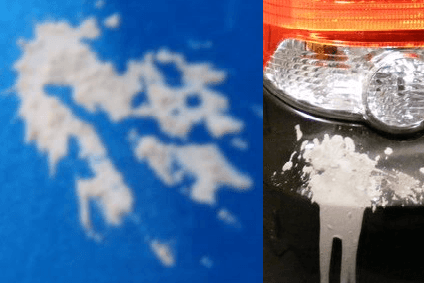
Also Removes Cement Splatter
Not long ago I received a letter from a couple in Michigan thanking me for saving them nearly $3,000.
The woman explained how she parked her husband’s car near a construction site and it was splattered with cement. Making matters worse, the cement stain wasn’t noticed until 2 days later.
She took the car for an estimate: $2,700 hard earned dollars to make it right.
Guys, this is not an uncommon story!
As a friend of mine used to say, “When all you have is a hammer, everything looks like a nail.”
Are insurance companies and paint/body shops purposely creating unnecessary work? I don’t now.
What I do know is this:
The answer to most hard water spots is distilled white vinegar. And yes, it works for minor cement spots too!
Time Tested Vinegar Solution – Works Every Time
Here’s the back story to this technique…
I actually learned this little trick from the old man that taught me how to plaster walls.
Every day I watched him wash his hands from a gallon jug of vinegar.
I thought he was strange. That is until my hands became so chapped and dry they started cracking.
But guess what!
The vinegar was instant relief. It’s instant relief for your car, too.
The solution is super easy.
Pour vinegar into a small bucket and use it to soak a clean sponge. A grout sponge from the hardware store works the best.
Place the sponge on the cement splatter stain.
WARNING! Do Not Wipe!
All you want to do is soak the cement stain with vinegar. Let the sponge sit on the stain for 2-3 minutes so the vinegar can do its job.
Then, simply flush the area with clean water. Repeat as necessary.
Dealing with Paint Etching And Stains
Minerals will etch paint if water spots or cement stains stay on your car for more than a few days.
Yes, using vinegar will remove the stains. But the paint may have etch spot (dimples) damage.
The only way to fix this common problem is to polish the paint.
And the best way to go about this is to use a good dual-action car polisher, (like the Porter Cable 7424XP).
A Good Polishing System is a Must
You can polish by hand, but you won’t have total success at making the etch marks go away.
Take it from me. I’ve done it.
Do the job correctly and get a dual-action car polisher.
But you also need a foam cutting pad, a foam polishing pad, and Meguiar’s Ultimate Compound.
Still thinking you can cheap-out and do the work by hand?
Trust me, you can’t.
You’ll rub, and rub, and won’t make a dent in the etch marks. The reason is because modern clear coat paint is too hard.
Your best bet is to invest in a good car polisher system.
There are actually a few brands worth considering. Griot’s Garage Polisher Kit and Porter Cable Polisher Kit are two of the best in my book.
Alternatively, you can hire a professional detailer. Expensive! Why not save money and do it yourself.
Next Steps!
Check out our Dual-Action Car Polisher Guide to learn more about safe car polishing.
Also see our Paint Repair Clinic series: How-To Safely Remove Road Tar, Tree Sap & Bugs!