
 Healthy paint is the foundation of a good looking, well-detailed car.
This is a BIG topic. Let’s get right to it!
First off, you are not alone. Detailers struggle with paint-related issues more than all other surface issues.
My promise is this…
Here you will find solid solutions for your car’s paint problems.
Before Attempting Paint Corrections… Read This!
I’ve decided to break up this material up into different pages.
You see, paint woes can involve many aspects.
(Links at the bottom of this page provide easy access.)
BUT wait a second!
Stay here and read THIS section first.
It’s especially key if you don’t already own and use a dual-action (DA) car polisher, like the Porter Cable 7424XP.
The Solution to Paint Problems
At the risk of sounding like a broken record…
(Does anyone even remember what they sound like?). Anyway, 90% of solutions to all paint-related problems involve polishing.
My friends, that’s both good news and bad news.

It’s good news because most paint defects are minor surface problems. They’re easy to repair.
In other words, you can quickly and easily make your car look like new again.
The bad news is you can’t do it by hand.
Why’s that?
The reason is simply this: modern clear coat paint finishes are very hard and durable.
The solution: A small investment in a car polisher.
But hear me out!
I’m not talking about a sub-par car waxer. Those tools may be OK for spreading wax, and that’s it.
Don’t cheap out!
You need a high quality dual-action car polisher – AKA an orbital or random orbit polisher.
Meguiar’s G110v2 is just one of the car polisher brands I recommend. The others are Porter Cable and Griot’s Garage.
See our Car Polisher Buyer’s Guide to learn more about the differences in these machines.
Extreme Makeover Meguiar’s Style
Have you seen the Meguiar’s Ultimate Compound and SwirlX bottles?
These labels display actual cars, in horrible condition. Meguiar’s reconditioned them.
That’s how proud they are of their products. Specifically, the polishes and the Meguiar’s G110v2 Dual-Action Polisher.
Have a look at this quick video!
It shows extreme makeover before and after shots. We’ll soon discuss how it was done.
Pretty amazing transformations on those cars, wouldn’t you agree?
Here’s one product label image I was referring to:
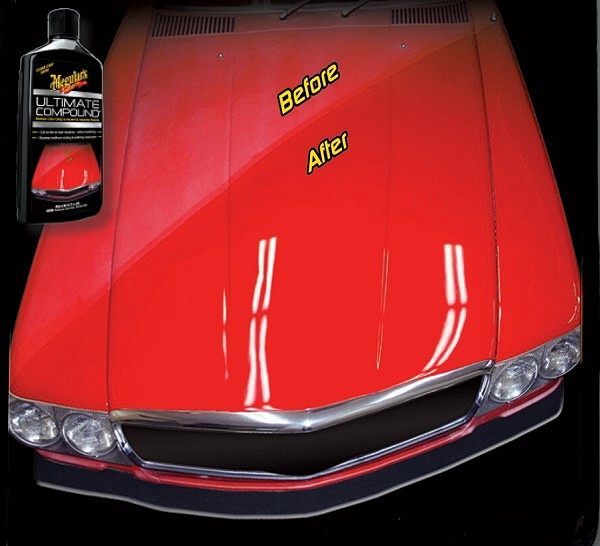
This is from the Meguiar’s Ultimate Compound bottle. Below is the Meguiar’s SwirlX product label.
Before you ask…
Yes, the car images were doctored a bit.
The emblems were edited out (removed from the hood and front grills) to avoid copyright infringements.
Now watch the video demonstration from Meguiar’s Asia.
It shows how well Meguiar’s Ultimate Compound works on an abused clear coat paint finish (BMW).
Note: The polish is applied with a Meguiar’s G110 dual-action polisher and the new Meguiar’s Softbuff 2.0 foam polishing pad.
Meguiar’s Ultimate Compound is the first step. It removes the scratches and heavy swirl marks.
Then, polish using Meguiar’s SwirlX (next video) to remove fine swirl marks and restore full gloss.
This is AFTER compounding with Ultimate Compound.
The thing is…
Meguiar’s SwirlX can be applied by hand or machine.
But let’s be frank…
Results by hand are limited, even if you rub, and rub and rub.
Take it from me guys!
Proper application requires a dual-action car polisher. Period!
Learn the Next Steps
As I said earlier, you’ll need a professional dual-action car polisher if correcting paint defects yourself.
Does that concern you? Horror stories?
Let’s put your fears to rest…
A dual-action polisher is not the same as a rotary, high-speed, buffer. You can’t damage your car with one.
That’s unless you club your car with it!
If you need more proof, read our How-To Use a Dual-Action Car Polisher page.
But here’s the most important part….
You must deeply understand the steps you need to take for your particular paint defect(s).
Here are the essential how-to articles:
At this point, let me offer a few more words of encouragement.
All of the techniques presented in these Paint Repair Clinic articles are tested and proven.
The methods work!
Car enthusiasts and professional car detailers use these techniques to bring some pretty horrible-looking cars back to life.
Here’s the secret!
-
- Take your time and;
- Always use the least aggressive products necessary.
Of course, I would add: Slow and gentle is best, especially while you’re learning.
It’s Time to Act
Stop messing around with hand polishing. Are really serious about your car’s appearance?
Invest in a dual-action car polisher. The best machine is the Porter Cable 7424XP.